
Julian Cousins & Associates
Members of the Jewellery Valuers Association and NAJ's Institute of Registered Valuers
Jewellery and silverware valuations for Insurance, Probate and Division of Assets in Kent, Surrey and Sussex

Prompt, professional jewellery valuations for Insurance, Probate etc. and Post Loss Reports, carried out at your home or office by an independent jewellery expert.
Valuation Fees
Standard one-off document fee: £70.00
Plus a charge per item or group of up to 5 lower value items*: £65.00
*Items with a value under approximately £500.00 are grouped as 'miscellaneous' and treated as one item.
Or Diamonds over 1 carat: £75.00 per carat
Where Can I Get A Jewellery Valuation?
The owners of jewellery shops are usually too busy to spend the necessary time on jewellery valuations. The really good ones, the ones who want to provide a good service to their customers (see our preferred partners for examples), will employ the services of someone like us, an independent jewellery valuer. We'll visit them once or twice a month and do their valuations for them. Or you could email us and we'll come to you, so you don't have to leave your jewellery with anyone. We'll appraise your jewellery in the convenience and security of your own home and send you your valuation a few days later.
Jewellery valuation is a highly specialised profession requiring the combined in-depth knowledge of the methods of jewellery manufacture, both historic and current; historic and contemporary design styles, the principal designers and their workshops; gemstone identification (Gemmology) and diamond grading; and a comprehensive understanding of the precious metals and diamond markets and the jewellery retail and auction market sectors.
"One High Net Worth Insurer estimates that 80% of new clients do not have adequate cover in force for their jewellery and valuable items"
To be fully insured, your jewellery items may need to be listed separately on your Contents Insurance Policy.
Our Accreditation
The Gemmological Association of Great Britain
The Gemmological Association of Great Britain, or Gem-A, is the world’s longest established provider of gem and jewellery education.They serve the interests of the gem and jewellery industries through the high standards of education on their courses and their support for global gemmological research.

The Institute of Registered Valuers
Jewellery Valuations with standards.
The Institute of Registered Valuers (IRV) is the UK’s leading authority of jewellery, watch and silverware appraisers who maintain exacting standards for the longest serving and most recognised valuation trade body, regulated by the National Association of Jewellers.
The Jewellery Valuers Association
The Jewellery Valuers Association is the only independent governing body in the UK exclusively for jewellery valuers. Its members comprise some of the most qualified and experienced professionals in the jewellery industry.
Membership of the Jewellery Valuers Association requires a recognised gemmology qualification, a recognised diamond grading qualification, a recognised valuation qualification and at least 5 years’ experience in the jewellery industry.
The Association of Independent Jewellery Valuers
The AIJV is dedicated to the professional growth of independent appraisers and related colleagues. Founded in 2010, it has quickly become an international organization advocating for transparency in the independent jewellery valuation practice.
What do I do next?
Whatever the purpose of your valuation, don’t delay.
Your insurance may be suspended until a full valuation is done, or Probate may be delayed.
The latest news from


Julian launches his Audio mini-guides
Julian's audio mini guides are now available to purchase and listen to direct from his website.
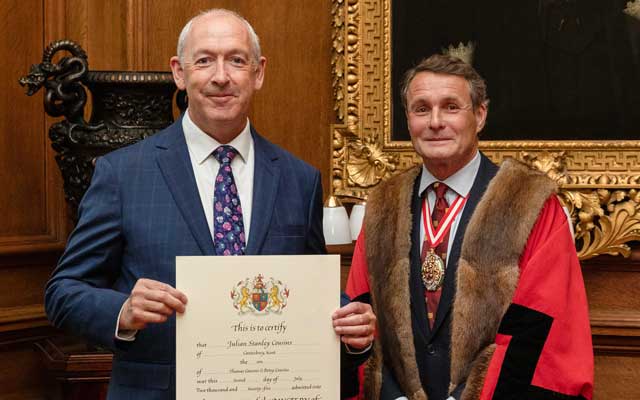
Admission into the Goldsmiths’ Company
Anna and I were honoured to be admitted to the Freedom of the Worshipful Company of Goldsmiths in a ceremony […]
What is a valuation?
You may need a valuation to insure your jewellery against loss or theft, or to help calculate the Inheritance Tax payable on a deceased person’s estate; it may be needed to help agree settlement in divorce proceedings, or to negotiate the security against a loan. Whatever your need, a valuation from a registered valuer – i.e. one with professional qualifications – is arguably the only valuation worth the paper it is written on.
If you’d like to have a look at what one of our valuations looks like, you can find one here Julian Cousins Valuations (ja-world.com)
Insurance
Post Loss Assessment
Family Division
Probate
"A recent Ecclesiastical Insurance survey showed that 23% of brokers believe all HNW (High Net Worth) clients are underinsured, which is 4% higher compared to the data in 2023. The survey also revealed that buildings (66%), jewellery (62%), contents (59%), and watches (53%) are the areas in which clients are most underinsured."

How does it work?
By far the easiest option is for Julian or one of his colleagues to visit you in your home. That way you don’t need to take your jewellery anywhere, or leave it with anyone, it can all be done in the comfort and security of your own home.
We'll need about 15 to 20 minutes to appraise each item on average, so we can process up to about 25 items in one visit. All we need is use of a space about the size of a kitchen table. You’ll receive a bound hard copy of your valuation and an encrypted PDF version a few days’ later.
If you’d rather leave your jewellery with a shop, please find our preferred partners here but please note, we may only visit these shops once or twice a month and the fees may not be the same.

What do I need to provide?
For all valuations, please provide all existing paperwork relating to the items to be valued: original purchase receipts, previous valuations, receipts for past repairs and any diamond, or coloured gemstone grading reports where available. These help provide a 'paper trail' of your ownership.
Failure to provide all relevant paperwork may result in a second, chargeable consultation. In view of time constraints it would be very helpful, but not essential, if the items could be cleaned before we arrive.

Cleaning
You don’t need specialist equipment to clean jewellery, just an old toothbrush (preferably a child’s toothbrush as the head is smaller) and some washing-up liquid.
Check carefully for any missing stones before you start. Gently wash the item, paying particular attention to the backs of the settings, in warm water, with a little washing-up liquid and the toothbrush. Do not press hard. Rinse and then dry with some kitchen towel. Check the settings again for any losses. If necessary, speak to your jeweller to rectify any issues.
Do not attempt to wash any jewellery where you can’t see the backs of the gemstones, i.e. if they are enclosed in metal (sometimes called a drum or foil-back).
Do not wash threaded pearls; use very mild detergent on mounted pearls and rinse thoroughly. Pearl cement can be water-soluble however, so you may prefer to let your jeweller do any cleaning of pearls.
If in doubt, ask a professional to clean your jewellery for you.
Warning!
Always, always, always clean your jewellery over a bowl, or at least put the plug in the sink!
Loose stones can be wriggled-out of their settings with over-zealous cleaning, but if they’re kept, they can usually be put back.

How much does it cost?
If you would like us to provide a valuation of your jewellery, you will be asked to sign our Privacy Statement and agree to my take-in explanatory notes and limiting conditions, which are the standard notes and limiting conditions of the Jewellery Valuers Association.
We would particularly draw your attention to item ix of our Terms & Conditions.
View and leave reviews
Jewellery Appraisers of the World provides a valuable resource to consumers wishing to find a respected Appraiser in their own area. All the Valuers featured on JAW are full-time professionals whose principal business activities are jewellery appraisal, valuation, gemstone identification and diamond grading. For your further protection, all JAW Associates featured on this directory have had their qualifications and memberships checked and verified.

Preferred Partners
Insurance
The idea of Insurance is to put you back in the same position you were before the ‘Insured Peril’ happened; you’ll see the word ‘indemnify’ in your policy.
A valuation for Insurance provides proof of the value of your jewellery, usually on the basis of what you would have to pay for it, if you had to buy a similar item from a retail shop, either second hand or new, depending on the item.
A fully researched and justifiable valuation enables a fair premium to be calculated and should reduce the chance of a challenge by Insurers in the event of a claim.
N.B. It is not considered proof of ownership.
Insurance
The idea of Insurance is to put you back in the same position you were before the ‘Insured Peril’ happened; you’ll see the word ‘indemnify’ in your policy.
A valuation for Insurance provides proof of the value of your jewellery, usually on the basis of what you would have to pay for it, if you had to buy a similar item from a retail shop, either second hand or new, depending on the item.
A fully researched and justifiable valuation enables a fair premium to be calculated and should reduce the chance of a challenge by Insurers in the event of a claim.
N.B. It is not considered proof of ownership.
Probate
Under Section 160 of the Inheritance Act of 1984, the estate of a deceased person is required to be valued so that “Death Duties or Inheritance Tax can be calculated, as applicable” by Her Majesty’s Revenue and Customs.
The value should represent the ‘open market value’, and is therefore completely different to the Insurance value and is usually considerably less. It is therefore important to have an appropriately calculated Probate valuation in order to mitigate tax liabilities, whilst remaining within the letter of the law.
Recent changes in HMRC guidelines means that you do not have to ask a professional to value an item with an open market value under £1,500, but take advice from your solicitor or the executor.
A 2012 article from the Guardian discusses the dangers of incorrect Probate valuations for bricks and mortar property, but it could just as easily be referring to jewellery.
Post Loss Assessment
Unless you’re here out of curiosity, we’re sorry you’re on this page, because it means that your Insurers have asked you to provide estimates to replace jewellery that has been lost or stolen but for which you don’t have any recent purchase receipts or valuations – now widely known as a Post Loss Assessment.
We valuers do not refer to this as a valuation because we are unable to inspect the items and the figures we arrive at are highly speculative, but hopefully we can arrive at a suitably justifiable figure that will enable you to get your claim settled as quickly as possible.
Division of Assets or Family Division
An independent jewellery valuation is often required to aid the fair division of assets in the event of divorce.
In order to prepare a valuation for matrimonial division of assets correctly, the following information is required in the first instance:
1. Confirmation that we would be acting for both parties. We regret that we are unable to provide valuations for one party only in this type of proceedings.
2. Confirmation whether the court has been asked permission to appoint an expert (jewellery valuer) witness. This is to determine whether a ‘standard’ valuation is required, or an expert witness report in accordance with the Family Court Procedure Rules Practice Direction Part 25 – Experts and Assessors
3. Confirmation regarding the market level of valuation. It is customary for division of asset valuations to be based on open market (auction) values, but the parties, their advisers, or the court can instruct the valuation to be on the basis of any market level, for example, Insurance Replacement values. In the absence of any specific instructions, it is my practice to provide both open market and insurance replacement values to facilitate agreement between parties.
On receipt of the above information we will be able to proceed to the next stage of providing a valuation.
Probate
Under Section 160 of the Inheritance Act of 1984, the estate of a deceased person is required to be valued so that “Death Duties or Inheritance Tax can be calculated, as applicable” by Her Majesty’s Revenue and Customs.
The value should represent the ‘open market value’, and is therefore completely different to the Insurance value and is usually considerably less. It is therefore important to have an appropriately calculated Probate valuation in order to mitigate tax liabilities, whilst remaining within the letter of the law.
Recent changes in HMRC guidelines means that you do not have to ask a professional to value an item with an open market value under £1,500, but take advice from your solicitor or the executor.
A 2012 article from the Guardian discusses the dangers of incorrect Probate valuations for bricks and mortar property, but it could just as easily be referring to jewellery.